Cradle to Cradle Institute publishes article on WBG Pooling as a pioneer in circular reusable logistics

The Cradle to Cradle Institute has published a comprehensive article about WBG-Pooling GmbH & Co. KG, praising the company as a pioneering player in genuine circular economy in European food logistics. The publication highlights the strategic importance of WBG Pooling’s reusable transport packaging and the consistent application of the Cradle to Cradle Certified® standard to promote material health, transparency and closed material cycles.

Holistic circular economy beyond regulatory requirements

Against the backdrop of the new EU Packaging and Packaging Waste Regulation (PPWR), this article shows that WBG Pooling already goes far beyond the minimum regulatory requirements. While the PPWR focuses primarily on recyclability and recycled content, WBG Pooling has been committed to genuine reuse and closed loops for years – an approach that significantly promotes the reduction of single-use packaging in food supply chains.

Cradle to Cradle Certified® as a strategic tool

The Cradle to Cradle Institute also highlights that WBG Pooling has been gradually certifying its product portfolio according to the Cradle to Cradle Certified® standard since 2022. The WBG Pooling BigBox 1000 product family was the first to be certified, followed by other product groups such as the WBG Pooling Foldable Crates and the WBG Pooling Logistic Pallets.

The certification supports the company in the following areas in particular:

  • Ensuring closed material cycles
  • Improving data quality along the supply chain, especially within upstream value creation
  • Strengthening sustainable procurement processes
  • Supporting sustainability reporting and financial ratings

Many of the certified products are also stackable and foldable, which reduces transport volume and lowers CO₂ emissions in empty transport.

Pooling model as a living circular economy

The article emphasises that circular economy is not a short-term measure at WBG Pooling, but rather a fundamental business model. The pooling system enables companies to use reusable packaging flexibly without having to own it themselves. This conserves resources, avoids waste and makes logistical processes more efficient.

Future-oriented corporate development

As reported by the Cradle to Cradle Institute, WBG Pooling is pursuing the goal of having all its proprietary products certified and further expanding its European partner network. In addition, the company benefits from the e-mobility solutions within its parent company, the Runden Group.

The company’s headquarters in Damme, Lower Saxony, already serves as an example of future-oriented infrastructure: the building is fossil-free, energy-efficient and designed as a net-zero emissions site with charging infrastructure.

Appeal to politicians and industry

The article points out that a successful transition to a genuine circular economy requires stronger political support and broader awareness of the advantages of reusable systems. Current subsidy structures and regulatory frameworks often continue to favour single-use packaging, which hinders the market penetration of circular solutions.

Practical experience

The WBG Pooling managers quoted in the article emphasise that companies do not need to have complete data transparency in order to start with Cradle to Cradle Certified®. The certification offers a clear structure, makes it easier to get started and reveals new potential for optimisation with each recertification.

The full article by the Cradle to Cradle Institute can be found here:
WBG-Pooling GmbH & Co. KG: Pioneering circularity in food logistics – Cradle to Cradle Products Innovation Institute

Circularity at the highest level: WBG-Pooling-L1- and -L3-logistics-pallets are officially Cradle to Cradle® certified

When resource consumption increases in parallel with economic growth, this is a linear economy; widespread and common practice in almost all industries worldwide.  In contrast to this are the circular economy and the Cradle to Cradle (C2C) principle.

The basic idea is that economic growth and the consumption of primary resources are completely decoupled from each other.

The C2C approach, developed in the late 1990s by German chemist Michael Braungart and US architect William McDonough, goes one step further:

While traditional models often have the aim only to minimize damage (“less bad”), C2C aims for a consistently positive environmental impact (“good from the start”).

It is therefore about well-thought-out product design that is geared towards the continuous reuse of materials and their complete return to technical or biological cycles at the end of their life cycle – without loss of resources and without downcycling.

WBG Pooling has been undergoing Cradle to Cradle certification for its product groups since 2022, starting with the WBG Pooling BigBoxes and the WBG Pooling Foldable Crates.

The WBG-Pooling-L1-Logistic Pallet light blue and the WBG-Pooling-L3-Logistic Pallet light blue are now part of the third product group to achieve successful certification – in this case at the bronze level.

The certification was carried out in accordance with version 4.1 of the standard, and a total of five categories were evaluated:

  1. Material Health – here, the pallets achieved the silver level:
    This means that there is no migration of harmful substances. The pallets are free of critical chemicals that could migrate into the packaged food.
  2. Product Circularity – here, the pallets achieved the silver level:
    This criteria ensures that closed cycles are used and that products are designed in such a way that they can be reused, repaired, or returned to biological or technical cycles without leaving any residue after use.
  3. Clean Air & Climate Protection
    This ensures that no harmful emissions are released into the air during the manufacture and use of the pallets. The criteria assesses whether the product’s carbon footprint is minimized. This includes the use of renewable energies in production and the avoidance of climate-damaging processes.
  4. Water & Soil Stewardship
    This category focuses on the responsible use of water resources and careful management of soil quality. Wastewater must be treated in such a way that no harmful residues are left in waters.
  5. Social Fairness
    This criteria focuses on fair working conditions throughout the entire supply chain, including living wages, safe working environments, and respect for human rights, both in the production of products and in the extraction of raw materials.

In addition, WBG Pooling identifies with the three basic principles of C2C:

  1. Waste is food
    All materials should be either biodegradable (composting) or technically recyclable (holistic recycling).
  2. Use renewable energy
    Production and transport should be powered by green electricity or solar energy.
  3. Promote diversity & reuse
    Products are designed to be durable, repairable, and modular.

The Cradle to Cradle seal offers several advantages for customers and business partners: The reusable pallets are free of harmful substances, the design and choice of materials support circular economy processes, and resources can be conserved collectively, which in turn contributes to compliance with planetary boundaries.

Economic transformation processes and circular product designs do not happen on their own – such milestones require strong partners at your side.

The certification of the pallets was easily implemented thanks to the manufacturing company, Craemer GmbH. As WBG Pooling acts as a system service provider, we rely on progressive suppliers who disclose their production conditions and are also committed to sustainability.

As with the other product groups, the certification was accompanied by EPEA GmbH – Part of Drees & Sommer.

And that’s what makes WBG-Pooling-logistics pallets so special:

They are easy to clean and, thanks to their material, resistant to moisture, bacteria, and fungi—ideal for the sensitive transport of foodstuffs such as dairy products, meat, or fruit and vegetables. In addition, they do not deform in cold temperatures and are ideal for frozen food logistics.

Unlike wooden pallets, there is no risk of dirt adhesion or wood fibers in production facilities.

The pallets are used in a closed cycle, cleaned, and reused immediately – the pooling system eliminates the procurement costs and disposal costs for disposable packaging and reduces greenhouse gas emissions by avoiding waste.

By the way: The C2C certification of the pallets ensures compliance with ESG targets! The use of this high-quality recyclable product reduces Scope 3 emissions in the supply chain and thus supports sustainability reporting in accordance with the Corporate Sustainability Reporting Directive.

Our review of the year 2023

When 200 people across Europe work on greener supply chains every day, a lot happens in a year, even outside of the typical day-to-day business.
We would therefore like to take you on a short journey through our year 2023 and present some highlights!

Right at the beginning, two major trade fairs came our way, and for the first time as exhibitors!
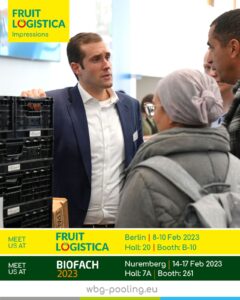
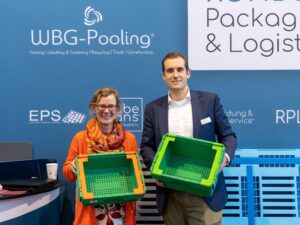
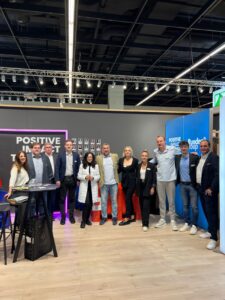
We presented our products and logistics concepts in close succession at FRUIT LOGISTICA in Berlin and BIOFACH in Nuremberg.
In addition to the volume reduction of load carriers, tracking using digital labels and platforms was also an exciting topic that we were able to inspire many visitors with.
We were present at both trade fairs together with companies from our parent company, the Runden Group.
We were also able to make excellent use of both events for an exchange with business partners – for example for the prototype of the “Eco Kiste”.

To round off what was already an intensive month, part of the team also visited the European Parliament in Brussels and took the opportunity to speak to some MEPs. The discussions focused primarily on the Packaging & Packaging Waste Regulation.

A big announcement was then due at the beginning of March – again, something we hadn’t done before, apart from the trade fairs.
However, we didn’t make the reveal quite so easy.

This was followed shortly afterwards by the dissolution: This year, we published our first German-language podcast called “MEHRWEG HEROES”. The aim: to raise awareness of circular economy issues.
The first episode went online on April 01, 2023.

But we’re not quite done with March yet: Internorga also took place this month and, of course, our category managers were there to find out about the latest trends and innovations in the sector.

At the end of April, we were then guests in Hamburg – where the “Branchendialog Fleisch & Wurst” organized by GS1 Germany took place, where we were able to visit BLOCK HOUSE production and listen to exciting keynote speeches.

In May, we were back in the Hanseatic city for the “Hamburger Logistik Tage” – together with other companies from the Runden Group, LHM-Pooling, Rubetrans Logistics and ecobyte, we exhibited here.

In June, our category managers held another interesting presentation for all participants at another event – this time focusing primarily on the baked goods sector.

Things continued in July with the LZ Strategietag Nachhaltigkeit & Verpackung.

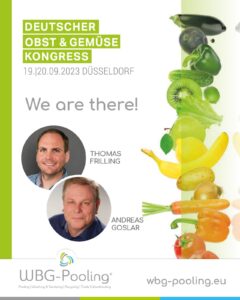
And the next congress with a presentation was already on the agenda: Our Country Manager DE/AT/CH and Category Manager Fruit & Vegetables were on site at the German Fruit & Vegetable Congress in Düsseldorf.

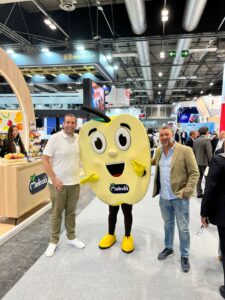
As a pan-European pooling service provider, we naturally also went beyond national borders: at Fruit Attraction in Madrid, our German and Spanish colleagues were able to gain valuable insights.

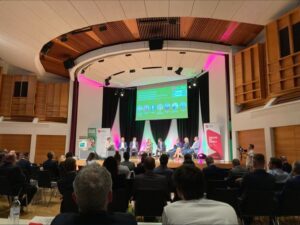
Then there was the Austrian Summit for Retail & Branded Goods…

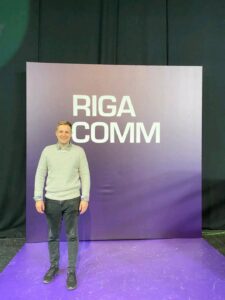
And the RIGA COMM…

…until all our international colleagues finally came together at ANUGA in Cologne! We were also exhibiting here for the first time this year and explained the economic and ecological benefits of reusable transport packaging in food supply chains.

Shortly afterwards, we were able to announce our second German-language podcast format, which focuses primarily on developments in the retail sector, more specifically food retail: RETAIL GUIDE.
While MEHRWEG HEROES is published weekly, there is always a new episode once a month on all podcast platforms and YouTube.

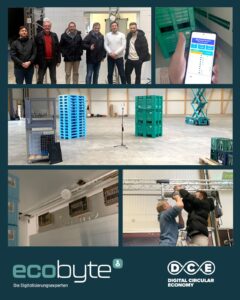
In October, our partner ecobyte also held an innovative, multi-day workshop with our load carriers. The main focus here was on the exchange of sensor data, low energy Bluetooth technology and full transparency within supply chains. This makes our reusable transport packaging smart and adds an important element to the already circular economy processes.

In November, we also had the pleasure of welcoming the Central Agency Packaging Register and taking the opportunity to discuss legal requirements.

In the same month, we went to the German Meat Congress in Mainz – where our Meat Category Managers Sofie Holt and Heinrich Kreymborg were also able to give a presentation on the opportunities of digital elements in supply chains with reusable transport packaging. Incidentally, we were able to exhibit here for the first time with a fresh logo.

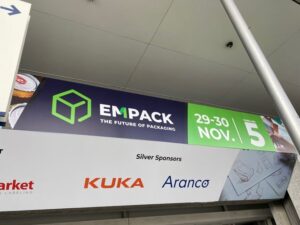
Of course, our Spanish colleagues were also present at EMPACK.

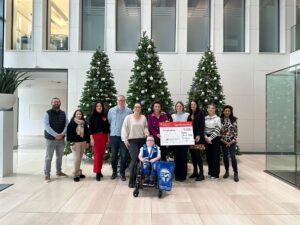
We were able to experience the crowning glory of the year in the hectic pre-Christmas peak of the season – the handover of the converted car for Jonah in cooperation with Aktion Kinderträume e.V..
Instead of expensive customer gifts, we were able to put the money to good use and make everyday life much easier for one person.
The cooperation with the association of the German meat industry has existed for several years and is always something very special for us.

We can therefore look back on a thoroughly eventful year with many first-time experiences, great moments and fantastic development in many departments.

Follow us on LinkedIn, YouTube, Instagram and all podcast platforms to stay up to date!


Login für QM